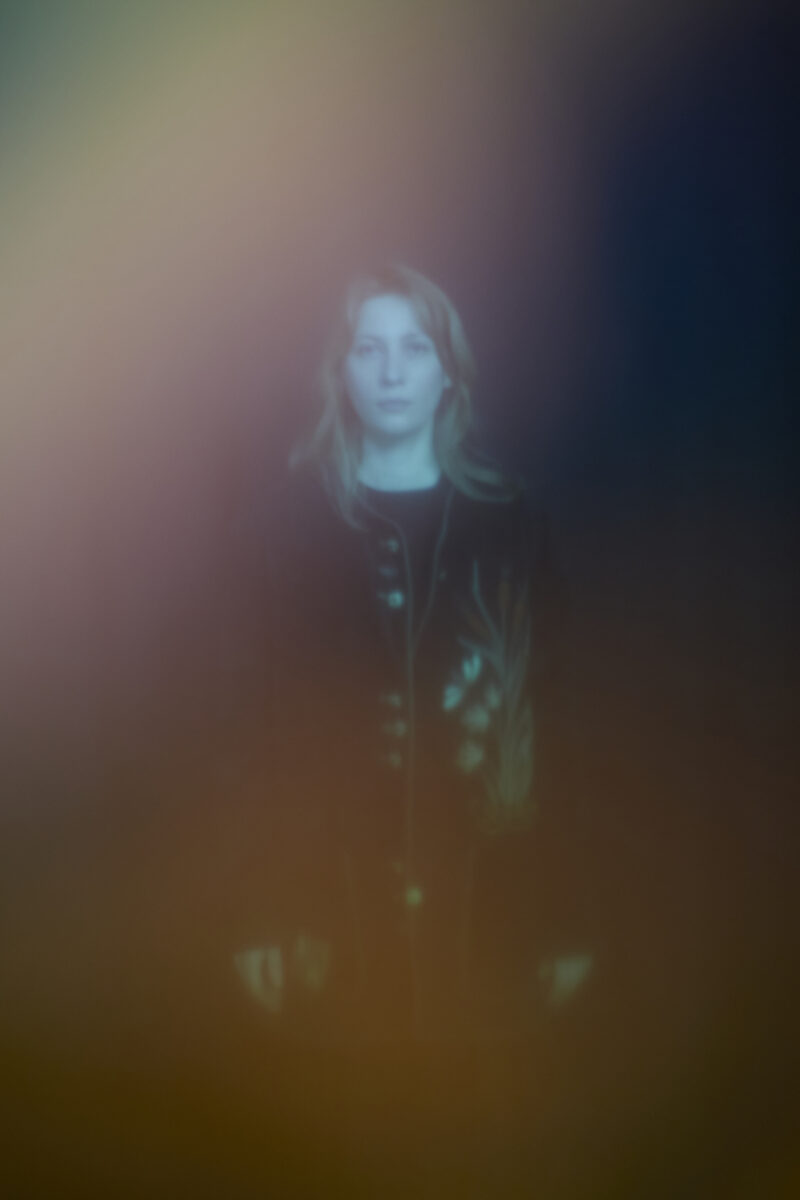
KRAAK FEST 2026 HIGHLIGHTS: Katya Shirshkova
Katya Shirshkova's electrifying vocal range is the stuff of transcendental lore and nature's perfect imperfections ~ the Russian artist, who is based in France, creates compositions and conceptual scores that result in highly hypnotizing polyphonic harmonies and dense performances, whether they are made for mechanical frogs or solely for the voice. She goes into detail about her past and current fixations, where she's been and what brought her to where she is now.
Tell us a bit about your background. What led you to music, and specifically to chant?
It began very naturally. My earliest sonic memory is being in my grandmother’s arms, listening to a church choir. I sang throughout my childhood, later feeling an urgent need to compose. As a teenager, I played in a band and eventually chose to study vocal technique professionally.
Although I graduated with honours, university left me with growing frustration. Instead of finding answers, my questions multiplied. The approach to improvisation felt like another form of constraint — shaped to produce a socially acceptable “product.” I felt the need to distance myself from vocal technique for a while.
Drawn to electronics, I shifted toward sound engineering and studied it for a year, becoming especially interested in acoustics. I later worked for several years as a sound engineer in underground venues, not much writing this period. Still, I kept questioning and searching for my voice — even only through listening.
A turning point came with open-score practices, influenced by Fluxus and avant-garde composers. During this period, I spent much time with my father, the artist Igor Shirshkov, whose way of thinking in painting deeply expanded my perspective. I’ve started to think about the practice wider, thinking more as an artist I guess…I also sense that many more backgrounds are yet to be discovered. Is the time linear?
Your “Le Héron” piece was released as a split LP with David Maranha “A reunião.” How did this collaboration come about?
I met Alex Zhang Hungtai, David Maranha, and Gabriel Ferrandini at one of their performances, where I helped as a technician. Their music left a strong impression on me. It was really an important concert — one that stays with you. Over the years, we kept in touch.
In 2023, David invited me and Yurii Kuznetsov to perform two pieces at the Appleton Festival in Lisbon. On a free day, while traveling by crowded train to Parede beach, all together we casually talked about music. Within that conversation, the idea of a split LP emerged. David created a special piece for the album - A Reunião.
You’ve worked on many different projects throughout the years! The first one mentioned on your website is "Pond". Can you tell us more about this piece and about how your music has evolved since?
"Pond" was crucial. I had a melody that came to me on a walk. The text translates roughly as, “how pensive is sadness in the garden in the evening.” I wrote three voices and decided to deconstruct the harmony using a grid devised by Ben Patterson, whom I met as a child. Ben once traveled on the Trans-Siberian train and stopped in Irkutsk (my hometown) on his way to Mount Fuji — it was around 2004.
For performers, I suggested learning the harmony by ear, allowing small deviations — similar to folk singing. During the performance, the melody repeated for 3–4 minutes. Then, one by one, vocalists would sing it and release a frog clockwise, determining the next performer’s pattern. As the frogs moved, the melody gradually fragmented into overlapping patterns. Finally, the last vocalist returned to the full melody, and the rest gradually rejoined it. Then again deconstructing. Then again reuniting. The performance lasted 25–30 minutes. About seven people attended — friends :)
It was essential that the grid not be rehearsed. Only the main tune was learned collectively. Ben once said he loved working with frogs because “they are not perfect.” The thing I discovered to myself through working with the grid was the memory imperfections. The melody we had learned slowly distorted with each frog’s motion, as human memory naturally reshapes what it recalls. From this memory imperfections revealed astonishing microtonal harmonies.
Another discovery was the state of collective presence – as performers, we were too focused on listening and following the frogs signs and the queue to “show off” vocally. It created a state of transparency — a temporary forgetting of the self. And perhaps, through that, a more pure presence became possible. This collective experience was so fundamental, though this quality still remains central to my practice.
Are there any other previous projects that had a specific impact on your creative process?
I would like to highlight "The Wind Blows Whenever It Pleases". It was a collective performative action conceived as a collaborative artistic gesture in response to military censorship and political repression. The action was documented and later released on Cancelled Records, and subsequently on Industrial Coast.
The work was an attempt to keep voices sounding through a chain-breathing technique — each participant could take a breath only while others sustained the sound. In this way, the voice never ceased; it became, at least for a while, a sound of solidarity and a means of transmitting what had become forbidden to speak about. In a sense, our voices became a living testimony to dissent.
The power of the human voice lies in its presence. Presence can carry a message — even a hidden one. People passing through the pedestrian crossing understood our message: some stopped and sang with us, others were moved to tears.
The fact that we were stopped by the police illustrates that sound has a political dimension. The value of the voice is not merely symbolic. It has a physical presence and a tangible impact.
Since your voice takes on such a big role in your work, are there certain rituals you perform in your day-to-day life to take care of it?
I warm up and sing in my daily life and before the shows, as I need my voice to be in a certain condition and because I like it:) But honestly, not every day. I also do physical exercises, as it influences the voice a lot, because the voice is the body. When the body or mental system is tired, it’s much harder to sing. Though I choose my practice according to body conditions, and sometimes a good sleep, rest, and silence are the best care for the voice.
Katya is on Instagram // Bandcamp // Web
Katya Shirshkova will harmonize the spirits this KRAAK Festival 2026 on March 14 at Het Bos, Antwerp. Tickets!